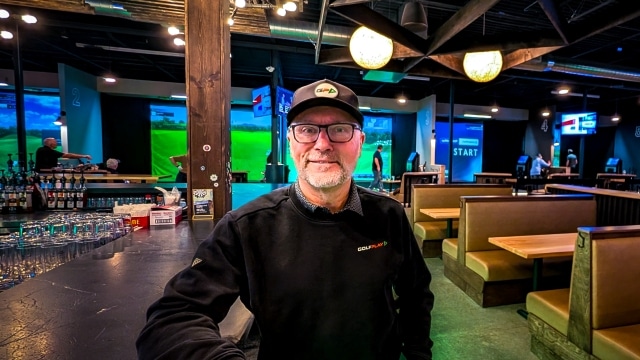
In depth with Golfplay founder and CEO Steve Harris
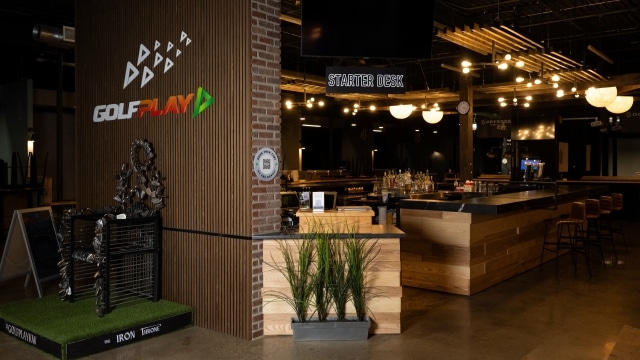
Steve Harris is a man on a mission. He’s the founder and CEO of Golfplay, a premium indoor facility that combines simulator golf with food and drinks and entertainment. They currently have locations in Kitchener and Waterloo, but Steve is looking to build on those successes and expand into other markets.
After a recent round of golf at the Waterloo facility, Steve spoke to Fairways about Golfplay.
Steve, first let me say that I thoroughly enjoyed my time at Golfplay and found it to be a much better experience than other outings I had to use a simulator. How did Golfplay get started?
A couple of things came together at the same time. I was having a successful corporate career with Cineplex in their digital media division and at one point, I got exposed to Topgolf because Cineplex was working with them to become the operator of Topgolf in Canada. I remember going to a Topgolf, I think it was in Dallas, on one of my business trips and looking at the people playing and realizing, wow, a lot of people here are not golfers. Clearly, they’re having a great time and there’s an interesting mix of food and beverage and music and exhilaration going on as people are hitting off this elevated platform into this giant field with targets, and I thought it was really interesting.
Around the same time, two other things happened. I had ended up at Cineplex because a company I was a partner in previously was acquired by Cineplex, and I joined their corporate team. But after six or seven years, I was getting a little restless with the whole corporate oversight and governance and strategy sessions and meetings and budgets connected to working for a publicly traded company . I’ve had a few businesses in my past, and I don’t know if I’m a control freak, but I like executing on my own ideas. And so, I got a bit restless and decided I was going to look for something else.
And that coincided with the time that I stopped playing hockey. I had been playing hockey once a week, seeing my buddies, having a great time, but my knees were giving me some problems, and I didn’t want to push it any further. And I remember thinking, okay, if I’m going to hang up my skates, I need to do something different that’s less strenuous but still provides an opportunity for socialization.
So, I started to play indoor golf at a place here in town with a friend. And we just joined the indoor golf league, something to do to get out of the house on a Thursday night. And it was fun. We had a great time.
However, I realized that I wouldn’t take my wife there necessarily on a date night. The food wasn’t very good. The environment wasn’t that great. The simulators weren’t that great. It just could have been better. And I remember thinking as I’m there having a good time, “I think I could do a better job than this. This could be much better.”
That was the beginning of me working on the idea for Golfplay. Having absorbed a little bit of what I saw at Top Golf and having some exposure from Cineplex on the food and beverage and entertainment side of things. And ultimately, I had this idea for doing my own thing.
So, what finally pushed you to turn your concept into reality?
I pitched the idea to Cineplex of working on an indoor golf / entertainment concept, but as they were working with Top Golf at the time it was seen as a conflict of interest. I worked out an arrangement for a graceful exit and eventually left the company and started Golfplay in the summer of 2017. I approached one of my hockey buddies and we talked about the idea a little bit. He came in as a silent partner and the rest, I guess, is history.
There are a lot of simulators on the market. How did you settle on Golfzon as your technology platform?
My initial thought was good food, in more of an entertainment style concept, with music and a nice environment. I didn’t really know which simulators I was going to use when I started. I hadn’t landed on Golfzon yet. I didn’t even know it existed. I was looking at Trackman and Foresight and HD Golf and Full Swing and some of the others that are still around. And I just wasn’t that impressed with any of them. And it was late in the game that a friend of mine sent me a link to this website called Golfzon.
It was a pretty basic website but I could see there was something very interesting going on with their simulators. I arranged to get a demo from OnScreen Sports, Golfzon’s Canadian distributor. They had a customer in Markham with a bunch of SIMs set up. It was very, very jammed with as many simulators as they could fit into the space. Not the nicest, but the technology was there and I was able to play on it and understand it a little bit better.
The Golfzon technology had this Auto-tee feature which was very impressive and the floor lifted and tilted to simulate sloped lies. But the best part was the instant rendering of a shot on the screen, as opposed to having a lag of a couple of seconds or second and a half that other systems had. The putting was also the best I’d ever seen.
So, I started to work with Bruno Tomasso at OnScreen Sports using Golfzon. It was a bit of a roll of the dice because at the time Golfzon was really unknown and kind of unsupported in North America, however, their product was excellent. We did have our share of technical learnings along the way, but the simulators were really good. And honestly, when we opened the door, it didn’t take long. I mean, the golfers just loved it. They just came in and couldn’t believe it. It was so much better than whatever they were used to.
It turned out to be the best decision I could have made. I mean, if I had selected anything else, we wouldn’t have been as successful. Absolutely, Golfzon is a huge part of our success.
Ten years ago, indoor golf facilities were still relatively new in Canada. What was your biggest surprise about jumping into this business?
I’ll say that I wasn’t really prepared for the group event side of things. I expected we’d rent our bays to avid golfers and do some league play, but we got a lot of corporate inquiries from people wanting to come in for a team building event or a Christmas party or a retirement party. And then there’s private birthday parties and bachelor parties and diaper parties and so on. I didn’t figure that out until the second year. We had a menu but we hadn’t really figured out what to do when a company wants to bring in a large group of people. So, it took a little bit of work to understand that we should have group packages and we should market it.
And a really important realization was that every time we bring a group in, typically a big chunk of that group has never been to our place before. They’re coming because someone else organized it, and it became an opportunity for us to show the place off to a whole new group of people who would hopefully tell their brother-in-law or their dad or whoever about this great place they were at.
The more groups we do, the more successful we become and the word of mouth gets out. And of course, we know that word of mouth is the best form of advertising you can get.
Was there anything in your previous experience before Cineplex that was entertainment related or sports related or anything that had a bearing on creating Golfplay?
No, nothing. And if I had known then what I know now, I probably wouldn’t have done it, honestly. No food and beverage experience. Here I am running a restaurant and a golf simulator place. I didn’t know how to run a bar. I was lucky to find some good people who helped me, and that was really key.
I grew up right behind Trafalgar Golf Club near Milton and caddied there as a kid and used to sneak on the fourth, fifth, and sixth holes across the back of the course and play them in the evening when I didn’t think I would get caught. Me and my sisters sold lemonade to the golfers and sold them back the golf balls they hit in the woods.
I’ve been around the game of golf all my life – my dad and grandfather both played – and I worked a few summers at Hornby Towers and Wildwood GC, so I had lots of exposure to the game but never really looked at it from a business point of view or as a career.
So, when this came along, it wasn’t really because of my love of golf that I thought, oh, I’m going to do this. Although I love the game, it was really a business decision. I just thought it would be successful. I felt there were a lot of people like me who would enjoy this kind of experience.
People tell me all the time, “These indoor golf places are popping up everywhere.” But they’re all limited in the type of experience they can deliver. They’re fine if you just want to hit balls and work on your swing, or are looking for a lower-cost, more basic option. At Golfplay, we’re able to offer so much more. Full service, great food and beverages and a fantastic vibe. Many golfers value a top quality experience. And so far it’s proven to be true. We’re having our best year ever.
How would you compare Golfplay as an entertainment product? It’s part pub, part restaurant, part sports facility. Is there a parallel?
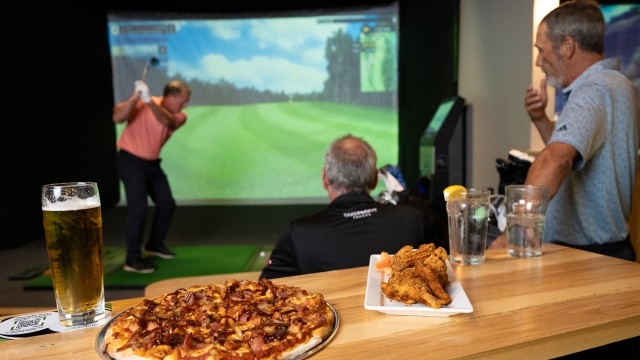
Bowling is probably the closest because there are lanes where you stay and the food and drinks are served to you as you play. It’s very similar to bowling, even to the extent that we run leagues during weeknights – we have over 600 players between our two locations. The weekends are prime time and get booked up quickly.
What’s your biggest competition?
Although we certainly compete with all the other indoor golf facilities, we are also competing directly with other entertainment options, like bowling, escape rooms or the movies. I think the one thing we’ve got going for us as opposed to other entertainment options is that the game of golf is not going anywhere. It’s a recreational sport played all over the world by millions and millions of people that love it. It’s not a fad like some of these other things that will be here for a while but then they’ll be gone. And our customers range from eight to 80, well, to 90 in my dad’s case. They play the sport for a lifetime and they enjoy the competitive socialization.
Where do your customers come from?
Our core customer base lives or works within 20 minutes of our locations. We also get people who will drive from further away because they recognize that we offer a premium experience. It’s much like golfers driving to a top course. They don’t really think too much about the drive because I think they’re excited to play.
A non-golfer would say, “Why would you drive an hour to that course and pay that much money to play golf?” But the non-golfer doesn’t get it, whereas a golf enthusiast would appreciate the quality of the course and the way it’s laid out and who designed it and the experience itself. And it translates exactly the same for us. We’re a premium indoor golf place, and we really try to be focused on delivering the best customer experience. I tell our staff all the time that the customer experience is our North Star. That is what we’re pursuing. And some of that’s delivered directly by the simulator technology, and we don’t have to do much. But everything that gets wrapped around it from where they park their car and what it’s like when they come in and how they get greeted and how we set them up in their bay and how the food is delivered.
I mean, there’s a lot of touchpoints that happen in a visit to our place, and we’re focused on trying to make all of them as good as they can be. We’re in the service business and we really try to stay focused on it.
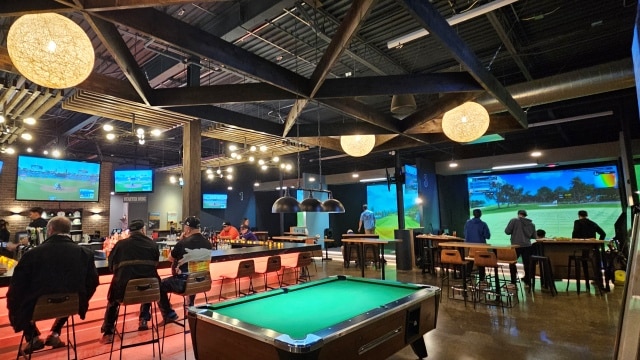
At your Waterloo facility, you have pool tables, ping pong tables, and darts. Are they revenue generators?
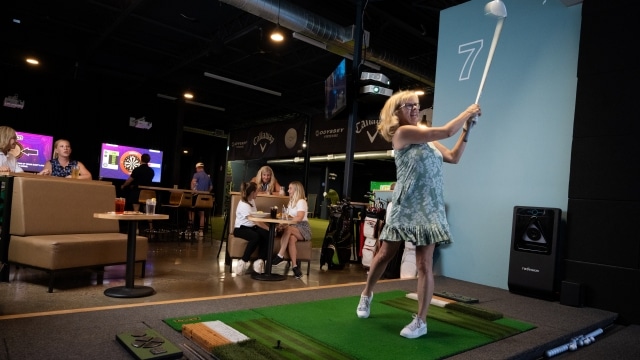
If I took a look at that and said, “Are we turning a profit on that pool table?” the answer is probably no, considering how much space the table takes up. And same with the ping pong tables. The darts do a little better, but the reason that we have them isn’t so much to generate revenue directly. It’s that not everybody’s a golfer and when we do a corporate event there will be a number of people who don’t golf. Since we don’t want to exclude them, we realized we needed to insert some alternate activities that would be easy and fun for everyone. So, pool, shuffleboard, darts, ping pong. These are things that anybody can play and have fun at. Augmented reality darts especially have been a really nice compliment to the golf.
As we go forward and open more locations, we’re always going to have other activities besides just golf. As I said earlier, we lean towards entertainment. We want everyone to have fun. We’re not here to take people from a 10 handicap to a five handicap. That’s not really our job. That’s not our philosophy. We’re here to facilitate a round of golf with your friends and set the stage for a good time. And if you don’t like golf, we’ve got lots of other options too.
You mentioned future locations. Is there something coming soon?
We’re planning a new location in the Mississauga area. I can’t say too much more about that now, but it’s exciting because that will give us a presence in the GTA. In addition, we’re also working with potential franchisees in several other markets throughout Southern Ontario.
My hope is that by next fall, we’ll have two more locations opening
Tell us about the franchising concept.
Our concept is based around having 12-15 bays in spaces of around 12,000 square feet. Large scale spaces are really important – especially for attracting corporate and group events. We believe that the Golfplay concept will work well in cities with a population of 125,000 or more, so that opens up a lot of potential markets. Because of the large scale investment required, owning a Golfplay may not be possible for everyone, however just like my experience, a silent partner may be the answer.
I’ve really enjoyed the process of developing and running Golfplay. I have come to know many people in our community, and because it is somewhat seasonal, it means my summers are quiet. It’s a great lifestyle business to own.
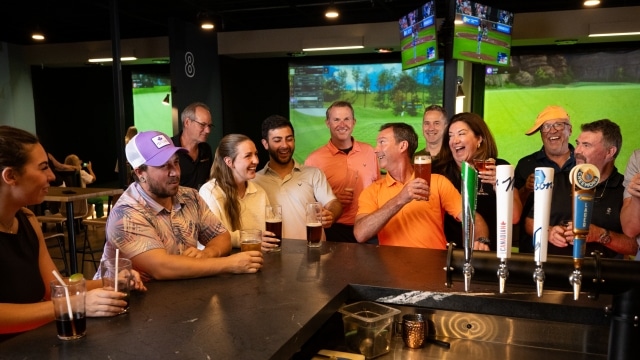
Your Waterloo facility is a bit bigger than Kitchener. Is Waterloo the model you’ll use going forward?
Yes, that’s the model. Any changes we might make would just be cosmetic. Scale is really important for our concept. If we had someone interested in a certain market and they said, well, I only want to do six bays because this is a small market and we can’t support 12, I would say, well, that’s not really the Golfplay concept. We’re about large scale so that we can host large corporate events and run big leagues. It’s like tables in a restaurant. If you’ve only got six bays, all of a sudden your kitchen’s not very efficient because there’s hardly any food orders coming in.
Scale is important for another reason too. Fundraising tournaments are becoming a growing part of our business. With 12 bays plus our VIP room available for a fundraising tournament, we can put two teams of three in each bay and have close to 80 people participating. And it’s more of a golf party than it is a golf tournament. We kind of position it that way and it’s lots of fun. It becomes a great social experience.
Can you give me an example of one of those things you tried that didn’t work?
Sure. Initially I thought we should not have chicken wings on the menu because they’re so messy to eat and you’re golfing. Who’s going to want chicken wings? I just said, “No, we’re not doing chicken wings.” Well, within two months of opening, we got so many customers saying, “How come you don’t have chicken wings? Where are the chicken wings?” So, that was a miss. And now we have them and they’re very popular.
One of the knocks people have against simulator golf is that it’s not really golf. You likely hear it too. How do you respond to that?
Well, I’m not ever selling it as a replacement for golf. It’s not. It’s a different golf activity. It’s indoors, it’s quicker. You can eat and drink while you play. It’s much more social, much more fun in some ways. So, it’s just a different golf activity, not a replacement. I love outdoor golf as much as anybody, but in any season I’m always pretty excited to tee it up at Golfplay too.
We have a lot of customers who tell us that they play more golf during the winter than they do during the summer because summers are so busy. Golf requires a lot of time and it’s often hard to fit into a busy summer schedule.
Any final thoughts?
I’m very excited to see what happens this next year for us. If we’re able to get franchising off the ground, I believe GolfPlay will be something that lands in a lot communities and people discover what a great experience it is. They just don’t know what they’re missing yet.
Steve, thanks for doing this. It’s been great chatting with you.
To learn more about GolfPlay and their franchising opportunity, click HERE.