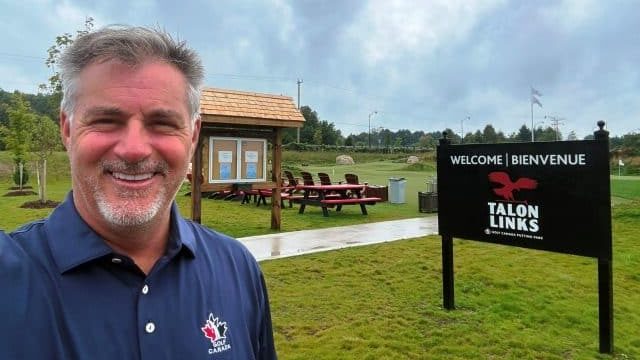
People behind the Game: Entrepreneur and Hall of Famer Grant Fraser
Educator, administrator, builder, writer, photographer, member of the Ontario Golf Hall of Fame. That’s quite a career with a distinguished list of accomplishments to go along with it. I’ve personally known Grant for over twenty years and after his Hall of Fame induction last year, wanted to dig a little deeper. Our interview was conducted for the most part in the weeks leading up to completion of the Golf Canada HQ in the Spring.
Welcome Grant. Let’s dial in the way back machine. How did you get started in the golf industry?
Well, it goes back to when I was a kid growing up in Etobicoke and hopping on the Eglinton Avenue bus to Scarlett Woods and arriving before 10 o’clock and paying a $3 green fee with my buddies and I loved it. And then as we got older, we progressed and moved up the road to Humber Valley and my summer jobs through high school and into university were also at golf courses. I worked at Lambton and St. George’s. I worked a couple of DuMaurier Opens way back when, shuttling LPGA players to and from the golf course. So, golf was in my blood at an early age. I never played competitive golf, but just loved everything about it.
When I was done school, I received a job offer from RBC to join their real estate group. And I thought, I’m not quite ready to do this. So that summer I was able to find a job at Glen Abbey as a starter. And it was a great summer. I got to play Glen Abbey pretty much every day. And when I was there, I met the likes of Dick Grimm, John Gordon, Mike Watt, and Steven Ross and spoke to them regularly about the golf industry. I knew that I didn’t want to be a banker for the rest of my life, so I was looking for ways to get into the golf business.
After I started working at RBC, I was also teaching at night at Humber College because I thought maybe I wanted to be a prof or a university professor, but I didn’t want to go back to school. I was kind of done. So, I was able to find a teaching position at Humber and I really loved it, but it still wasn’t in golf.
I remember calling the PGA, it was the CPGA at the time, and having a conversation with their director of education. And I said, “I’m kind of struggling here. I want to work in the golf business, but don’t quite know the pathway in. What do you suggest?” And the person I spoke to at the time said, “Well, we’ve got these two golf programs that have just started up in Alberta, one at Grant McEwen and the other at Lethbridge College.” And she said, “Why don’t you check those out? That might be a good option for you.”
I was recently out of school and had some student loans to pay and thought, I’m not doing that. So, I said to her, “Why isn’t there a program like that in Ontario?” And she said to me, “Well, we’ve tried, but we haven’t got anywhere with the colleges that we’ve talked to.”
So, that was my first light bulb moment. I thought, okay, I’m teaching at Humber College, I’m a part-time guy, but maybe Humber would be interested in starting a golf management program. I knew the president at the time was a member at Lambton. So, in the summer of 1993 or 94, I can’t remember, it’s over 30 years ago, I made an appointment to see the president of Humber College, Robert Gordon. It’s the middle of the summer and there’s nobody there, but he agreed to see me because he wanted to talk golf. So I said to him, Dr. Gordon, I’ve got an idea here. It’s a unique opportunity for Humber College. We’d be the first out of the gate in Ontario, and there’s no other program like this anywhere other than Alberta. And he was quite intrigued by that.
So, Dr. Gordon convened another meeting with his senior staff and I pitched the idea to them. Then he said, okay, let’s get the CPGA here. The executive director at the time was Dave Colling and Dave came with his director of education, and next thing I know, I was given the green light to start a golf management program at Humber College.
So, with that, I went to work. I flew out to see the two coordinators at Grant McEwen and Lethbridge. The guy at Lethbridge was a gentleman by the name of Dean Sprittle, who still is very much involved in the golf business, and both of them couldn’t have been more helpful or more supportive. They both said, “Whatever you need.” So went to work.
We had an existing three-year business program at Humber, and then I put a golf spin on it and we never looked back. It took me a couple of years to get it going. Our first intake was in 1995, and we had 54 students, and then it took off from there.
I teach entrepreneurship in the golf program at McMaster. And I start out by asking my adult learners, “What is it that you’re trying to do? What’s the problem that you’re trying to solve?” And if you think about any business, they all started because someone thought, “I can either do that better or nobody’s doing this or this needs to be fixed.”
For me, I wanted to find a way to get into the golf business but kept running into all of these obstacles. So, my light bulb moment was, “Okay, I’ll start a golf program. And I’ll do it at Humber College.” And that’s what I did.

I didn’t know you at Humber but met you early on in another venture called the Golf Management Institute of Canada. Did that morph out of your work at Humber College?
Not exactly. Professional Golf Management (PGM) programs were backed by and supported by the PGA of Canada. And what they wanted from PGM programs was to fill the pipeline with aspiring golf professionals. And we did a pretty good job. Between 1995 when we started at Humber to 1999 when I left, enrollment tripled. We went from 50 to 150 or 160 students, all with the intention of coming into the program to be a golf pro. But as you and I know, there are so many career paths in golf. So, my new idea was to expand the golf program and create pathways for someone that wanted to work as a club manager or a retail specialist or hospitality, food and beverage, even turf.
Looking at the resources that the college had at the time, I thought perhaps we had everything we needed. But I just couldn’t get the dean from the turf management school and the hospitality school and the school of business all on the same page at the same time. They all liked the idea, but as you can imagine, getting three deans to agree and figure out how we’re going to do this together, it just didn’t work. The president of the college still liked my idea of creating an institute, something bigger and more all-encompassing. But after a couple years of trying, I thought, I’m done. So I resigned. I walked away from the program that I’d started at Humber, and started the Golf Management Institute of Canada (GMIC) but I’m proud to tell you that after 30 years, the golf program I started at Humber still exists.
Tell us about the GMIC?
I started the Golf Management Institute of Canada in 1999, and it was the first online school in Canada. That doesn’t sound like a big deal now in 2026 – oh yeah, online education, big deal – but in 1999, nobody knew what online education was. I had the University of Phoenix and Athabasca University as my benchmarks, as my models. And I tried to figure out what they were doing in the online universe. I had support and backing from Bruce Simmonds at ClubLink who was very, very kind and liked the idea and several others in the industry.
Our curriculum was comprised of 10 online courses, and we launched the first one in October of 2000. We had 13 students take our human resource management class, and we never looked back. So, for 17 years, the GMIC worked independently. We offered our own graduate studies diploma. And then in 2017, I had an opportunity to partner with McMaster University and move the program over to McMaster’s Center for Continuing Education. And it still exists today, and I’m still involved with it.
That’s really very commendable Grant, but shouldn’t this have been something that the PGA of Canada did?
Well, listen, I’m glad they didn’t. And I’m glad nobody else did either. Apparently, no other college or even a university wanted to get into the online space at that time. I thought it might be an opportunity. As I said about entrepreneurs, “What’s the problem that you’re trying to solve?”
When I was at Humber, I would get a lot of calls from adult learners saying, “Look, I’ve got a job. I’ve got a young family. I can’t go back to school. Do you have any night classes? Or is there another way I could take this program?” And it’s like, “I’m sorry, it’s all offered in class during the day.” Another light bulb moment. Okay, we’ll bring it to you. Our original tagline when we started the GMIC was “Online education anytime, anywhere.” Because it didn’t matter where you were, you could take an online class. And it didn’t matter the time of the year. We were running our classes 12 months a year.
Even today, no other institution or organization in Canada has jumped into that area of online education for golf. Just McMaster and the GMIC. That’s a competitive advantage, certainly for McMaster.
Weren’t you involved with the PGM program at Niagara too?
I was. When I left Humber to start the GMIC in 1999, a colleague of mine who was at Humber with me left to become the vice president of business development at Niagara. Her name was Martha Cass; she loved golf, was a fellow entrepreneur, and someone I really enjoyed working with. And she called me and said, “Grant, I’ve accepted this new position at Niagara. I’m going to start a golf program down here. Would you like to be part of it?” And I said, “Well, Martha, I would love to, but I’m starting this online school, so I’m not going to walk away from that.”
But from one entrepreneur to another, I said, “Well, why don’t we partner? You don’t need to reinvent the wheel here. I’ve got all the curriculum, I’ve got faculty. Let’s partner.” So Niagara College and the Golf Management Institute of Canada officially signed their first partnership agreement in 2000, and that partnership lasted for 19 years.
But Niagara’s program, their first intake was in the fall of 2000. Or maybe it was 2001, but all of the golf management programs or courses that were delivered in the Niagara PGM program were actually licensed to them by the Golf Management Institute of Canada. So, it was a great partnership.
Is the content that you’re teaching in a PGM program the same as what you’re delivering in the GMIC continuing education program?
Well, it’s similar but the delivery is different. Instead of an in class, face-to-face, chalk and talk, lecture type delivery mode, the online platform is exactly that. It’s online, more self-directed study, and the audience is different too. PGM students come into college when they’re 18 or 19 or 20, and they leave three years later. The GMIC target market was much different. It was adult learners, career changers, people looking to advance their career. So the average age was probably late 20s, 30s, even 40s, and a very eclectic group. I had accountants. I had golf professionals. I had people already in the business, a lot of military people looking to get into golf because they loved the game, but wanted to pursue a career. So, it was a very different audience compared to the students that I taught face-to-face when I was in class.
The other differentiator for the GMIC was you could enter into the program at any time. If you think about colleges and universities, you start Labor Day week. That’s frosh week. And then you go to Christmas and then you come back and you start your January semester, and then you’re done in April and you’re off for the summer. But we ran our online classes throughout the year. So if you couldn’t start in September, okay, that’s fine. You could join us in November, December, and then you would just follow our course sequence from there. It was very, very flexible learning, and that was done with intention.
Our full curriculum was 10 courses and that led to a diploma. But you could also just cherry-pick whatever courses you needed. I remember receiving a call from a GM saying, “I’ve got this wonderful assistant superintendent who I’m looking to promote. I want her to take your online class in turf management golf course design.” So, she did, and within a year she was the superintendent at this golf course.
Both in teaching and the development of the Humber program and the GMIC, you must have engaged some really fascinating people. Any that spring to mind?
I can’t say exactly how many people have taken a GMIC course or I’ve taught but it would be in the thousands, so there’s a lot to choose from. I also think about all of the people that supported me personally and supported the vision of the GMIC to bring online education, golf management education to anyone who wanted it. I suppose one of the things I take a lot of pride in is just seeing a lot of graduates who either went through the GMIC program, Humber or Niagara, working in the golf business, who are now in leadership roles doing wonderful things. Terry Kim, for example, who’s a graduate of the Niagara program is the director of golf at TPC Toronto at Osprey Valley. Drew Atkinson, another Niagara College grad, is working with Golf Canada as the director of sales and marketing. Craig Cupito, a very senior person at ClubLink who looks after nine golf courses, is a Humber College grad. So just seeing what they’re doing and watching them pursue their dream, their passion, that gives me a lot of satisfaction.
So, switching gears here a little bit, I’m not sure where our paths first crossed, but I’ve certainly known you as a travel writer for some time. How did that start?
So again, I go back to putting on my entrepreneur hat and asking the question, what’s the problem you’re trying to solve? In the 90s and early 2000s when golf courses were being built to the tune of anywhere from five to seven opening up in Ontario every year, there was a book called The Green’s Fee Passport, and it offered coupons. That’s all it was. It was a coupon book, two-for-one, four-for-three and so on. I looked at that book and thought I could improve on that model. So, I decided to write a book.
It was called The 50 Greatest Public Golf Courses in Ontario. So, I drove around the province for two years photographing and writing about what I thought were the best 50 public golf courses that you and I or anybody else could play and then I had it published. I ended up partnering with the NGCOA for 10 years, creating another publication called Golf Access and it also had two-for-one or four-for- three coupons. So, in answer to your question, it all started because I wanted to provide information to golfers, but I also wanted to give them incentives to play the best public golf courses in Ontario. So that’s how I got into the travel writing business, Peter.
I just went out and did my own photography and my own writing and I’m still doing it today. And I love telling stories about great places that I have traveled to around the world.
What’s your favorite place that you’ve been to?
Yeah, I often get asked, and I know you do too. So what’s your favorite golf course? Well, that’s a toughie, right? Because are we talking links, ocean, desert? But I think if you had to drop me off anywhere and say, this is your last round of golf, I’d tell you to take me to the island of Lanai in Hawaii so I could play the Manele course at the Four Seasons Resort.
Okay, cool. I know you’ve done other things too. You currently manage a driving range and for the last four years, you’ve been heavily involved in the construction of Golf Canada’s new headquarters at TPC Toronto. Is there anything I’ve missed that you did during this time?
No, I’m still involved with the T-Zone driving range in Oakville. I oversee it for Bot Construction in Oakville. It’s a family-owned construction business. I wrote the business plan to turn 40 acres of farmland into a going concern for the Bot family and we opened our doors, I believe in September of 2014. I’ve been involved from the very beginning but now we’ve hired a golf course superintendent named Peter Kinch, to look after it, who does a wonderful job. I just provide oversight now.
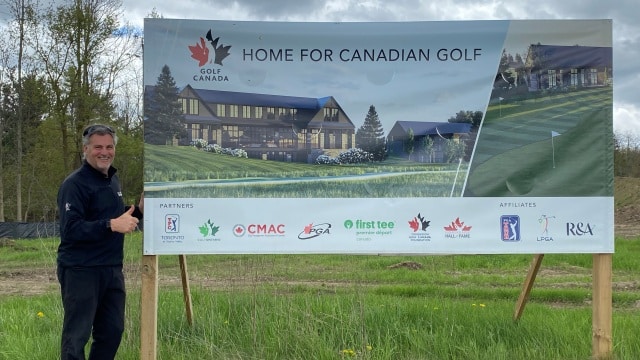
But most of my time today, the majority of my time today is spent on the Home for Canadian Golf Project, which saw Golf Canada leave Glen Abbey in Oakville and relocate their headquarters up to TPC Toronto at Osprey Valley.
They built their own 26,000 square foot national headquarters and there’s a community putting park called Talon Links. So, it’s quite an impressive endeavor that Golf Canada has embarked on. And I’ve had the pleasure and privilege of serving as the project manager for the last four years.
What did you find most challenging about it and what did you find most rewarding?
There have been challenges, no question. I think my biggest challenge was to get occupancy so that staff could move in on time and we were able to do that. So we received official occupancy on April the 10th of 2026, and then staff’s first day was the following Monday on the 13th. We were able to get that done. That was a big deal.
And then of course bringing the project in on budget. We’re close, but that’s been a challenge. We’ve assembled a great team. I’ve got a wonderful general contractor, fabulous architect, a good group of engineers and we’ve all come together.
And everyone knew that June 8th, 2026, is the week of the RBC Canadian Open and all the finishing touches had to be complete for that. The landscaping had to be done. The siding had to be put up on the building so that when spectators came from across Canada, and those watching on TV around the world, we wanted to make sure that what Golf Canada has created is world-class and that if the spotlight’s going to be on us, we wanted it to show well.
Can I add one thing?
Absolutely.
You asked me how did I end up working for Golf Canada? Well, I was a volunteer for Golf Canada for many years, and I was involved in something called Golf in Schools. And that was part of the work that I did at Niagara College where we raised money to introduce the Golf in Schools program into the elementary schools in the Niagara region. And I give my golf management students full credit for doing that. So, every year we would raise enough money to introduce the program into at least two schools in the region. I was thrilled to be part of that program, but the bottom line is that I was a volunteer with Golf Canada for probably 10 years before I ever assumed the role of the project manager on their new HQ.
Cool. Okay, one more thing to add to the list of accomplishments. The question that has been kicking around in my mind for some time is that you’ve been an entrepreneur, you’ve identified problems and solved them. Do you have an itch at the moment about some other problem that needs to be solved? And where do you go next? What’s in the future?
Right now, I haven’t identified a problem that needs to be solved, but I don’t think I have a best before date. If there’s a problem to be solved and I have the wherewithal and the energy to solve it, I will. I’m interested in doing things that are of interest to me. And I think about my entrepreneurial journey and writing my first book and starting Golf Access and Humber College and Niagara and the GMIC, and now the work I’m doing for Golf Canada. I’m as excited today about doing the work I’m doing as I was from day one. So the passion and the fire in the belly is still there. So as long as it’s still there, then I’ll keep doing things. So I’m not done. It’s not like, well, okay, I’ve started several businesses. I’m done. I’m going to play golf five days a week.
No, I’m not going to do that. I want to keep doing things.
Yeah, I certainly wasn’t suggesting that you’re done. I’m just saying I know that the Golf Canada headquarters job is coming to a close, so there’s going to be presumably a lot more time available to do other things. I’m just wondering if there was something that you had your sights on.
I do. Golf Canada, they’re forward-thinking. They’re looking at something called golf in small spaces. And so I don’t know what my role will be going forward with Golf Canada, but if there is a role to help develop and grow the game, I would ask to be part of it.
Can you elaborate on golf in small spaces?
Sure. The premise is that our golf season is short but that doesn’t mean our interest goes away during the cold months. Golf can be 12 months of the year. Once you put your clubs away at your golf course, you can pull them back out again and go play simulator golf. Or we have putting parks like Talon Links at the Golf Canada head office where communities will be encouraged to come and play an actual putting course. It’s not mini golf. There are no windmills and waterfalls. It’s an actual putting course designed by a golf course architect named Paul Jansen from Himalayas Golf. It’s on two acres, which is a lot, and it certainly doesn’t have to be that large, but just bringing people into smaller spaces.
And I’m actually hearing about golf developments in shopping malls where people can roll some putts or chip or hit a ball into a net. So I think you’re going to see more of that going forward.
Okay. So, when you look back at it all, is there one thing that stands out as the most rewarding?
I guess what stands out most to me are all the people that helped me at various stages along the way from Humber to GMIC to Niagara to McMaster to Golf Canada. If Dr. Gordon at Humber had said no to my idea, we probably wouldn’t be having this conversation. And so many more.
But I think what I’m most proud of, as I said earlier, is seeing what the graduates from the different programs that I started are doing now and how well they’re doing in the golf business.
Grant, thanks for doing this. It’s been great chatting with you.