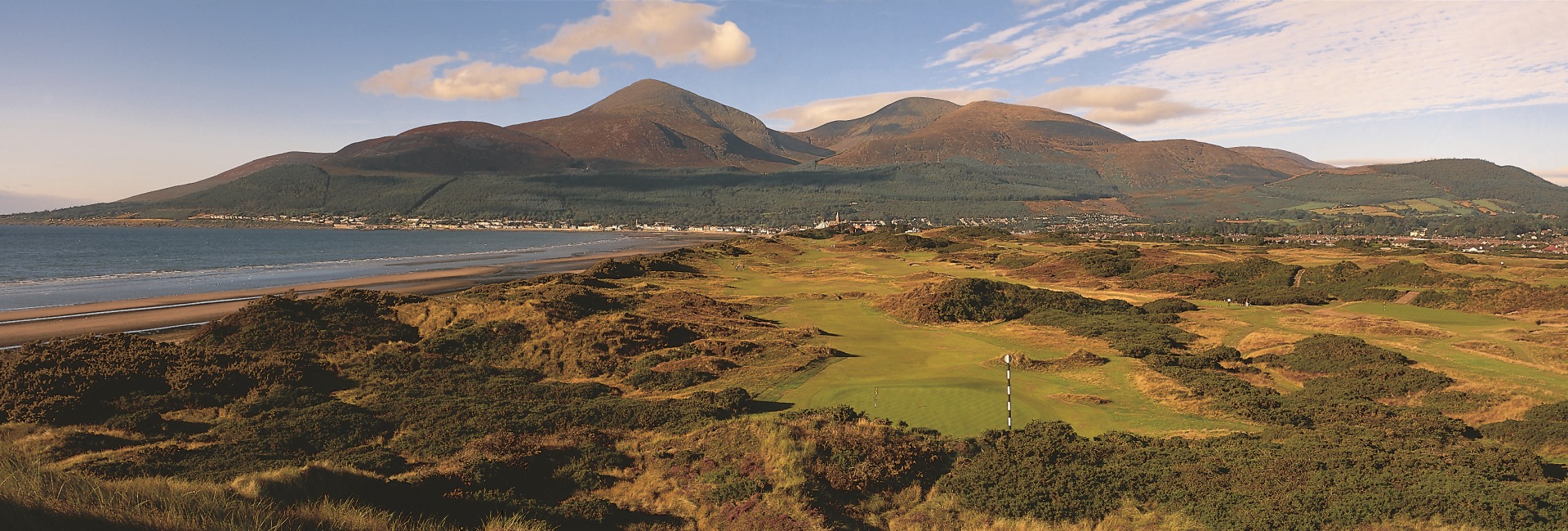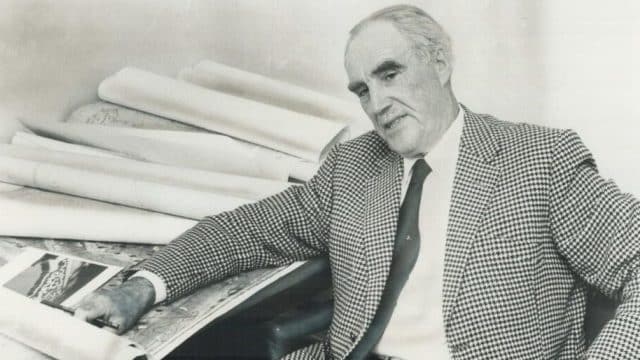
Robbie Robinson: The quiet architect who carried the Thompson tradition forward
Above photo: Golf Canada
Few Canadian golf-course architects have had a greater influence on the development of golf architecture in this country than Clinton E. “Robbie” Robinson. Yet Robinson remains considerably less familiar to golfers than the man who taught him, Stanley Thompson, or the younger architects he subsequently mentored.
That is somewhat surprising given the breadth of his career. Robinson designed, remodelled or expanded well over 100 courses—and some estimates put the number of projects he was involved with at close to 300—across Canada, the United States and South America. He also played an important role in turfgrass management and education and served as president of the American Society of Golf Course Architects (ASGCA) twice. He was inducted into the Canadian Golf Hall of Fame in 2002.
From agriculture to golf architecture
Robinson was born in 1907 in Saint-Amédée, Quebec, and graduated from the Ontario Agricultural College in Guelph in 1929. His agricultural education would prove unusually valuable in a career that eventually combined golf architecture, construction and turfgrass management.
Immediately after graduation, Robinson joined the practice of Stanley Thompson, one of Canada’s pioneering golf architects. He spent approximately 10 years working with Thompson, gaining experience not only in drawing courses but in actually building them. Among the projects with which he was associated during this period were some of Thompson’s most important Canadian courses, including Capilano, Cape Breton Highlands and St. George’s.
One of the most important lessons Robinson absorbed from Thompson was that golf-course architecture should begin with the land. Routing, views, natural features and the way a golfer experiences the property were more important than imposing a preconceived design upon it.
Robinson subsequently became superintendent at Sunningdale Country Club in London, Ontario, where he was responsible for maintaining Thompson’s original course. When Sunningdale expanded to 36 holes, Robinson designed the new West Course, demonstrating that he could take Thompson’s principles and apply them in his own way.
The influence of Robert Trent Jones
Thompson was not Robinson’s only significant influence. Following the Second World War, during which Robinson served as a Royal Canadian Air Force pilot, he spent a period working with Robert Trent Jones Sr. That experience exposed him to a considerably different approach to golf architecture. Jones was becoming one of the dominant figures in postwar American golf, and his courses tended to be more substantial in scale, with larger greens and a stronger emphasis on strategic challenge.
The combination of Thompson and Jones helps explain why Robinson’s work doesn’t fit neatly into the category of a pure Thompson disciple. Golf architecture historian Keith Cutten has described Robinson’s style as something of a hybrid: Thompson’s strategic thinking combined with the more expansive tendencies associated with the era in which Robinson practised. Doug Carrick has made a similar observation, noting particularly Robinson’s large greens.

More than an architect
Robinson’s contribution to Canadian golf extended well beyond course design. His agricultural background and practical experience maintaining courses led to a particular interest in turfgrass. In 1949 he became director of the Green Section of the Royal Canadian Golf Association, a position he held for almost two decades. He was instrumental in disseminating information about turfgrass management and helped establish Canadian turfgrass education programs and shows.
This background had a direct influence on his architecture. Robinson understood what happened to a course after the architect left. He knew how much labour was required to maintain bunkers, greens and roughs, and he understood the importance of designing a course that could be maintained within the resources available to its owner. That practicality became one of his trademarks.
Some of his most significant courses
Robinson’s portfolio is unusually broad, but several Ontario and Atlantic Canadian courses illustrate his work particularly well.
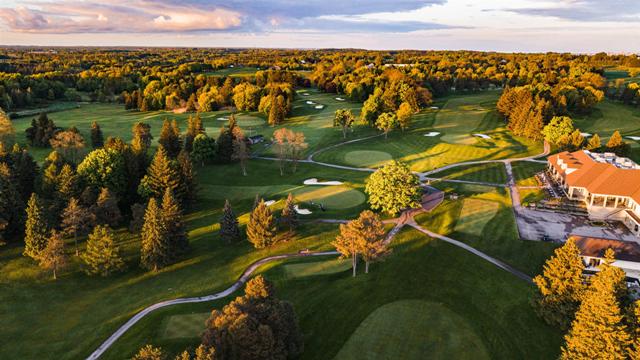
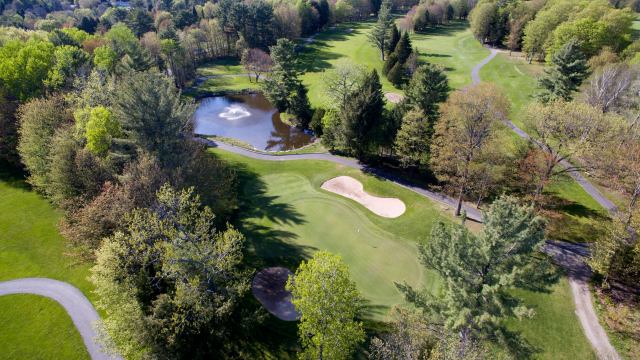
Beverly Golf & Country Club near Hamilton is an excellent example. Built between 1957 and 1960, the course takes advantage of naturally rolling terrain, a creek and small lake. Robinson created generous greens with significant contours and generally left openings that allowed golfers to run shots onto the putting surface rather than requiring every approach to be carried through the air.
Credit Valley Golf & Country Club in Mississauga, Cedar Brae in Scarborough and Dalewood near Port Carling are among the other Ontario courses with which Robinson is closely associated. On Prince Edward Island, Brudenell River and Mill River are particularly important examples of his work. The American Society of Golf Course Architects identifies Brudenell and Mill River among the courses of which Robinson was especially proud.
His work at Oakdale Golf & Country Club in Toronto is particularly interesting from a historical perspective. Robinson designed the additional nine holes in the late 1950s, creating what became the Knudson nine. When Oakdale hosted the RBC Canadian Open in 2023, the championship routing brought together three generations of Canadian golf architecture: Thompson’s original holes, Robinson’s nine and later restoration work by Ian Andrew, who in turn was mentored by Doug Carrick.
Robinson also undertook significant modifications to existing courses rather than simply creating new ones. His work at St. George’s Golf & Country Club is particularly notable. He made major changes to the Thompson course during the 1960s, work that was later continued by Doug Carrick. Robinson was again involved in preparing St. George’s for the 1989 Canadian Open.
Other courses by Robinson include Cambridge Golf Club, South Muskoka Golf & Curling Club, nine holes at Lake St. George and a second nine at The Briars.
Did Robinson have a signature style?
It is probably more accurate to describe Robinson’s work as having a design philosophy rather than a highly recognizable visual signature.
His courses tend to emphasize playability, strategic options, generous greens, natural terrain and practicality. At Beverly, for example, the club specifically identifies several recurring Robinson characteristics: greens angled to the line of play, bunkers positioned to the sides rather than completely blocking the entrance, substantial putting surfaces and interesting contours.
Perhaps most importantly, Robinson believed golf architecture had to work for ordinary golfers as well as accomplished players.
The architects he mentored
Perhaps Robinson’s most enduring legacy is the architects who followed him. The best-known is Doug Carrick, who apprenticed under Robinson after graduating in landscape architecture from the University of Toronto in 1981. Carrick credits Robinson with teaching him the principles he had inherited from Thompson while also emphasizing practicality, maintenance and playability.
Robinson also mentored Tom McBroom, who would become one of Canada’s most influential modern architects. Bob Moote is another name associated with Robinson’s mentoring and professional circle. Carrick himself has specifically identified Robinson’s mentorship of Carrick, McBroom and Moote as part of his legacy.
There is therefore a fascinating architectural family tree behind Robinson: Stanley Thompson → Robbie Robinson → Doug Carrick and Tom McBroom, with the Thompson philosophy evolving at every stage rather than simply being copied.
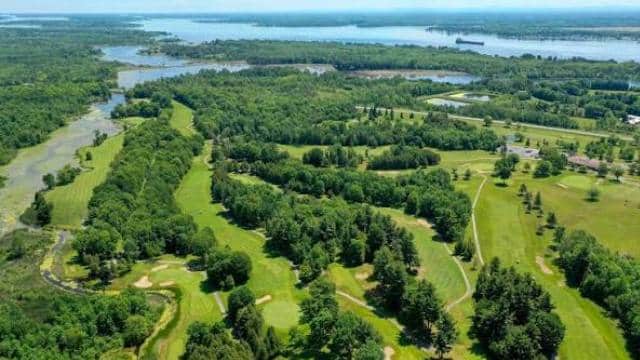
Carrick, who worked for Robinson beginning in 1980, has said that Robinson taught him to think about the average golfer, maintenance requirements and the balance between challenge and playability. Robinson himself reportedly summarized his approach in remarkably simple terms: “Good design is never done on paper.” He preferred designing with his eyes and responding to the land.
That philosophy also explains why so many Robinson courses remain comfortable rather than contrived. He was capable of producing strategic challenges without making courses excessively punitive.
In researching this article, I had several questions for Doug Carrick:
What was the most important thing you learned from Robinson that helped shape your career?
Doug Carrick: Robbie really encouraged me to think about how to design a golf course that not only challenges a skilled golfer but also how to design a course that will accommodate golfers of average skill. We spent a lot of time discussing where to place bunkers and how to create angles of play that allow for flexible course setups for championship events and for regular daily play. He taught me about traffic patterns around greens and tees and how bunkers can restrict traffic flow and create wear problems around greens. We talked a lot about his experiences with Stanley Thompson and what he learned from Thompson. Creating variety and artistic flare with bunkers etc.
In your opinion, what was Robinson’s most defining contribution to Canadian golf?
DC: Robbie was very pragmatic and practical. He designed many golf courses with modest budgets, courses that were affordable and accessible to for the majority of golfers. He also designed and remodelled some great golf courses including St George’s, Westmount, Bayview, Credit Valley, Brudenell, Mill River and Cedar Brae. I think the quality of his work often is overlooked or under appreciated and he was quite prolific with more than 50 new golf courses and 70 plus golf course remodels or expansions to his credit. Robbie also served as President of The American Society of Golf Course Architects (twice). Robbie was an expert in turfgrass management, and he established the RGCA’s Green Section and served as the Director for many years. He also mentored a few golf architects including, me, Tom McBroom and Bob Moote.
What was Robbie like to work with?
DC: Robbie was great to work with. He was a great teacher, very patient, laid back and a true gentleman. He was generous with his time, his knowledge and introduced me to many of his clients and other prominent people in the business. I was very fortunate to meet and work with Robbie early in my career and I know I wouldn’t have had the success I’ve had in the business without his guidance and influence.
A lasting Canadian legacy
Robbie Robinson died in 1989, but his influence continues to be visible on Canadian golf courses. His importance lies not only in the number of courses he touched but in the bridge he created between the classic Thompson era and the modern generation of Canadian architects.
He took Thompson’s emphasis on strategic golf and natural landscapes, absorbed some of the larger-scale ideas of Robert Trent Jones, added his own understanding of turfgrass and maintenance, and developed a practical form of architecture that could work on both prestigious private courses and modest public facilities.
That may ultimately be Robinson’s defining contribution: he demonstrated that good golf-course architecture did not require extravagance. It required understanding the land, understanding the golfer and understanding how a course would actually live after it was built. His courses—and the architects he taught—continue that legacy.