
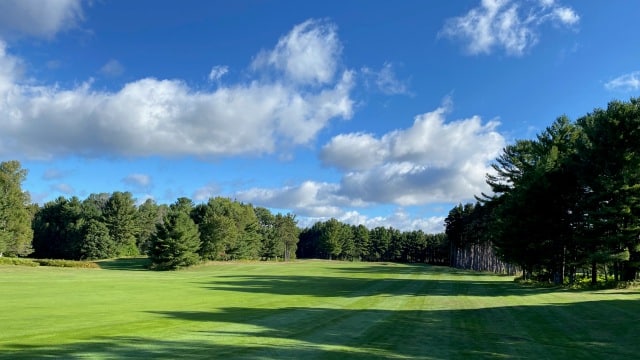
On the road to Elliot Lake, Ontario
Our destination this week takes us to Elliot Lake and two amazing golf courses that generate feelings of shock and awe – shock that two golf courses this good could be found in the remote woods of Northern Ontario, and awe at the exquisite settings of Huron Pines (pictured above) and Stone Ridge.
Elliot Lake is mid-way between Sudbury and Sault Ste Marie — about five hours from the GTA — and twenty minutes off the Trans Canada Highway. It’s pure Canadian Shield as evidenced by massive rock ridges, pristine lakes and dense forest. Stone Ridge Golf Club is adjacent to town, while Huron Pines is 20 minutes further west along Hwy 17 in the town of Blind River. Both towns evoke fond memories from my childhood of traversing Northern Ontario on cross-country family holidays.
The town of Elliot Lake itself is a quite a story.
From Uranium Boomtown to Northern Retirement Haven
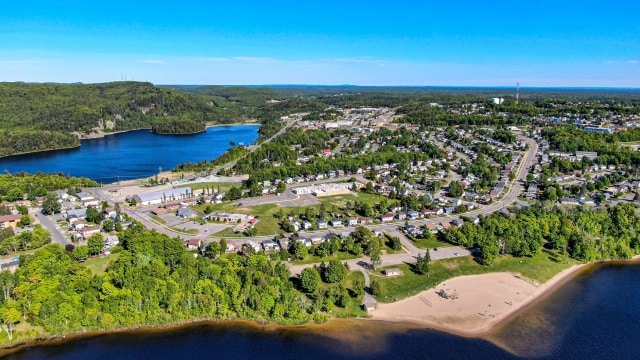
There are few communities in Ontario with a more remarkable story than Elliot Lake. Built almost from scratch in the 1950s as a uranium-mining town, it experienced spectacular growth, a dramatic population collapse and, ultimately, an unlikely reinvention as a retirement community and four-season outdoor destination.
The Elliot Lake area has a much longer history than its modern city might suggest. Indigenous peoples have lived in and travelled through the region for generations, and the area later became important for fur harvesting and logging. Commercial logging began expanding into the region in the late 19th century, with large stands of white pine attracting lumber companies.
Everything changed in the early 1950s with the discovery of uranium.
The federal government and mining companies quickly recognized the potential of the deposits, and Elliot Lake was conceived as a planned community to house the miners and their families. Construction began in 1954-55, and neighbourhoods were designed with schools, churches, parks, shopping areas and recreational facilities rather than simply being a collection of mining camps.
The growth was extraordinary. By 1960, Elliot Lake’s population had reached almost 25,000. But the boom was followed almost immediately by a bust when uranium demand declined and American contracts were not renewed. By 1966, the population had fallen to about 6,600.
The community survived, however, and uranium mining experienced another resurgence in the 1970s and 1980s. Eventually the mines again began closing as uranium prices weakened and reserves were depleted. The final Elliot Lake uranium mine, Stanleigh, closed in June 1996.
Reinventing Elliot Lake
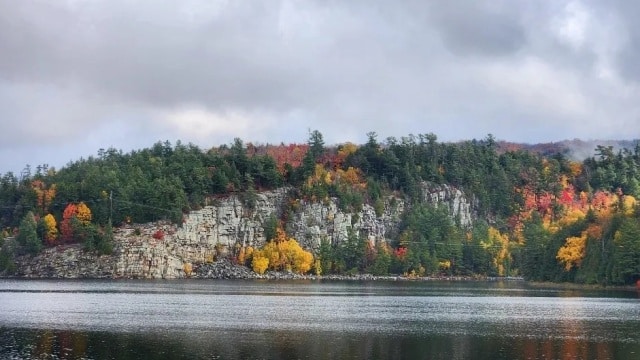
The remarkable part of the Elliot Lake story is what happened next.
Rather than allowing the city to become another abandoned mining community, residents and municipal leaders began looking for a new economic model. Tourism, small business and, most significantly, retirement living became central to that strategy.
Beginning in the early 1990s, vacant houses and apartments were marketed to retirees looking for an affordable alternative to larger Ontario communities. The strategy made sense: Elliot Lake already possessed many of the characteristics attractive to retirees—established neighbourhoods, shopping and services, health-care facilities, recreational infrastructure and an extraordinary natural setting. A municipal age-friendly initiative later described the transformation as creating a new primary industry based on residents themselves.
That retirement identity remains important today. Elliot Lake promotes itself as a community where residents can combine the conveniences of a small city (population 11,000) with access to wilderness almost immediately outside their doors. The surrounding landscape provides forests, lakes, trails and opportunities for boating, fishing, hiking and winter recreation. It is an unusual retirement proposition: instead of moving to a condominium in a large urban centre, retirees can trade the traffic and congestion for lakes, forests and four-season recreation.
And of course, there’s golf.
The Courses
Stone Ridge Golf Club
Elliot Lake, ON
18 holes / Green fee: $56 Walking
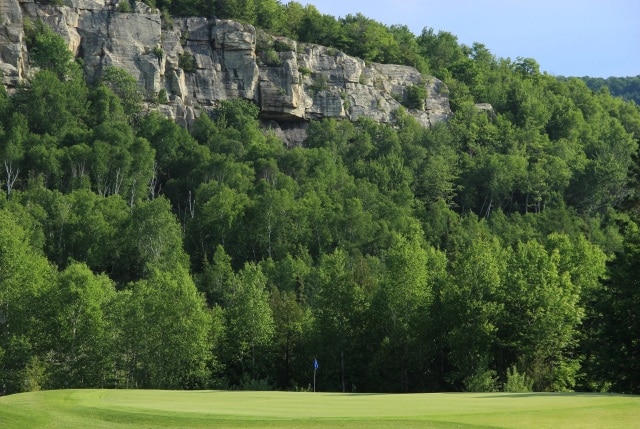
Stone Ridge Golf Club is one of Northern Ontario’s premier 18-hole championship courses. Designed by renowned architect Ted Baker, the course stretches 6,800 yards and offers a dynamic blend of natural beauty and strategic challenge. Since its opening in 2005, Stone Ridge has earned praise for its dramatic elevation changes, pristine fairways, and breathtaking views of rock escarpments, boreal forest, and Ryan Lake. Stone Ridge is a visually stunning and technically demanding experience, designed to challenge seasoned players while remaining playable for everyone.
In the words of the architect himself: Rarely does a golf course architect have the opportunity to work with a site of such exceptional beauty. The escarpment, the lake, the wetlands, mature vegetation, exposed rock faces, and dramatic elevation changes – the design fits effortlessly into the landscape — Ted Baker.
Huron Pines Golf & Country Club
Blind River, ON
18 holes / Green fee: $56 Walking
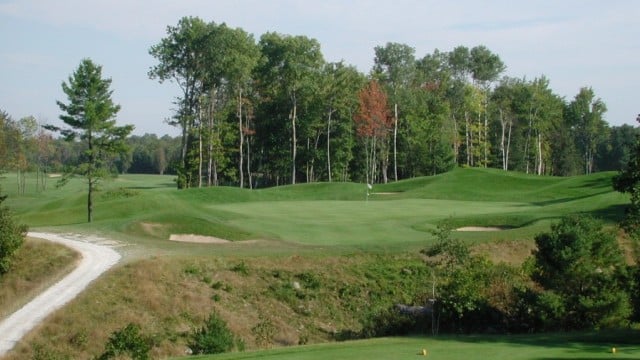
Huron Pines is another of Northern Ontario’s most scenic and well-regarded championship golf courses. Established in 1984, the course is nestled alongside the Mississagi River and surrounded by hardwood forests, signature white pines, wetlands, and exposed rock. The original nine holes were designed by Robbie Robinson, a protégé of Stanley Thompson, and reflect a natural integration with the landscape. The back nine, added by Graham Cooke, is a seamless transition between the two designers, offering a wonderful routing that wends through the pine forest and finishes with a brilliant 5-par along the river.
I’ll have full course reviews in upcoming issues, but for now, let me say that I can’t stop talking about both courses. They’re that good. Stone Ridge has dramatic elevation that offers spectacular vistas of the adjacent ridge and provides a natural setting for some brilliant par-3 holes. Huron Pines is flatter and presents a more tranquil experience, like an afternoon walk in the woods.
One of the things that will astound golfers used to big city pricing is that green fees at both courses are just $56. That’s not a misprint. They would both command a much higher rate closer to a major urban area.
For my latest trip, I stayed at the Hampton Inn in Elliott Lake and had dinner at Chuck’s Roadhouse. I’m already planning a return visit and will be joined by a number of friends. We’ll likely turn it into a two or three-night stay and play both courses at least twice. And sample more of the abundant natural beauty of Elliot Lake and the surrounding region too.
For more info on either of the courses mentioned here, click on the course name or image.



Excellent article! I lived on the Nordic mine townsite, when it was an active mine and worked as a student labourer building a nine hole course. It is wonderful to see how the course has morphed into the beautiful Stone Ridge Golf Course. Thank you, Bob Bourne