To Fit or not to Fit?
Recently, I have been working with a few people going through custom club fittings which prompted this article.
A successful club fitting should not begin with a club, a launch monitor or a computer. It should begin with a conversation. Before we discuss shafts, club heads, launch angles or numbers on a screen, we need to understand who’s in front of us, what they want for their game, and what they are realistically prepared or willing to do.
About 30 years ago, I taught at an indoor facility that allowed 100 yards of ball flight. We did not have today’s simulators, launch monitors to measure and interpret every detail of a shot. Instead, I carried a clipboard as I wanted to know the golfer’s background, how they learned, what they wanted from lessons, and whether there were any physical limitations or restrictions that might affect their ability.
That was 10 to 15 years before TPI Golf Fitness and a Certification which helped me develop a better understanding of mobility, stability and flexibility. Mind Factor training added another layer: how golfers should think, play and practice. Technology gives us invaluable information, but the fitting process still requires the older skills of observation, good conversation and good judgement.
Questions for us to Ask
Do we fit for compensation or do we fit for potential?
Fitting for compensation may be a technically correct term, but its practical purpose is often to create greater enjoyment. It means helping golfers within their capabilities or limitations, while taking into account their swing, body, available time, interest and budget.
Fitting for potential looks farther ahead. It assumes the golfer has the willingness and ability to improve through coaching, physical training, practice and change. Neither approach is right or wrong. The real question is, are we fitting the golfer of today or who they are prepared to become.
Do your current clubs allow you to play well? Does your body allow new clubs to meet your expectations?
Age can be a factor, but so can mobility, stability, flexibility, injury history and general physical capability. A new club cannot perform the physical work the golfer is unable—or unwilling—to do. Expectations should reflect the current body that will actually swing the club, not the body the golfer remembers having years ago. The same is true of belief. A golfer may have equipment suited to greater potential, but if confidence, trust or expectations do not support any equipment changes it may be an exercise in frustration.
Do you have the time and motivation to train your body?
Potential requires more than a purchase. It may require better movement, improved strength or balance, and consistent physical preparation. Compensation may be the wiser choice when training is not possible or simply not going to be possible or a part of the golfer’s purpose.
Do you have the time and motivation to develop your skills?
Lessons and fittings usually chase two familiar outcomes: better direction and more distance. Equipment can help with both, but practice habits, playing frequency and willingness to change still matter. Clubs fitted for potential may not help if the golfer never works at developing the swing they’re getting fitted for. Think about this, are you in like with a particular club or do you love the result you get from hitting that specific club? Fall in love with the sight, sound & feel of the target!
What can technology tell us?
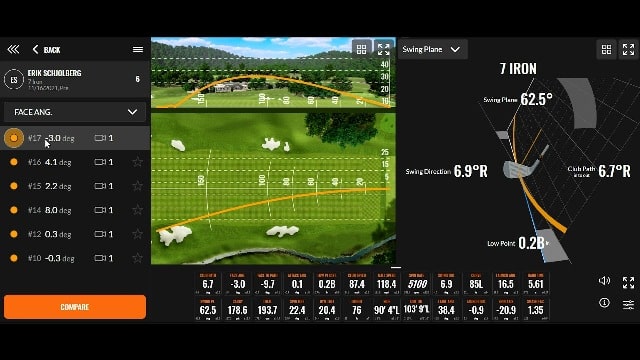
Modern technology can measure club and ball speed, launch, spin, direction, distance, strike pattern and many other useful factors. It allows clearer comparisons and can expose equipment that is poorly matched to the golfer. Used well, the information can improve decisions, reduce guesswork and help the golfer understand why one option performs better than another. Facts to support a decision.
What can technology miss?
Technology cannot fully measure what the golfer sees, feels and hears. The sound at impact, the look of the ball flight and the ability to turn data into a usable feeling all influence performance. Whether a golfer learns visually, through feel, or by sound, every shot still needs to connect the body and club to an intended target—from tee to fairway, fairway to green, and green into the hole.
Golfers usually have a favorite club in their bag. They are not in love with the club; they are in love with the result or outcome they get with that particular club! The Coach or Fitter must marry the measurable information with the personal traits, interests and learning preferences of the golfer.
When is custom fitting necessary?
Custom fitting becomes especially valuable when equipment is clearly mismatched, physical capabilities have changed, direction or distance is being compromised, or the golfer is making a meaningful investment in a new set of clubs.
It may be less urgent when the golfer’s purpose is purely recreational, the budget or physical capabilities do not support a major purchase, or the willingness to practice and change is limited. Sometimes a smaller tweak like equipment adjustment, a shaft change to original club, a lesson or an honest conversation may provide better value.
Pros & Cons of a Custom Fitting
Advantages: better information, more useful equipment comparisons, improved comfort, confidence, direction, distance and enjoyment.
The disadvantages can include too much data, sales pressure to buy, manufacturer or inventory bias, and expectations that a purchase will solve problems better addressed through coaching or practice. Buyer beware does not mean distrusting every club fitter. It means understanding whether the process is truly centered on the golfer or simply moving toward a sale. Age and budget also deserve the same honest consideration as technology and your numbers.
The Conversation Still Matters
The best fitting process marries the golfer’s swing, thinking, learning style, equipment and ball flight to the TARGET. Before TPI, Mind Factor and launch monitors, teachers relied on observation, ball-flight laws, body movement and a practical diagnosis. Today we have so much information, but we still have to turn all of the information into solutions the golfers can trust and use for their enjoyment.
A successful fitting should not begin with a club. It should begin with a conversation—and sometimes that conversation begins in your own head with a trusted Coach before the cost reaches your wallet.
Fitting or appropriate Par-ting thoughts for you to think about!
The modern fitting information should add technology to the human assessment, not replace it.
The better process marries the mind/body with equipment and numbers to your purpose or target.
In general, if you weaken a shaft, you strengthen a swing and if you strengthen a shaft, you weaken the swing.
There’s a difference between feel and real when it comes to a good fitting.
The accurate facts from technology may prove different and affect your decision. In my 1st fitting as a senior golfer, the fitting provided me with information that I did not like or agree with but remove the ego, and the fitting helped me play better. My last fitting a year ago felt better, the clubs looked better and performed even better. Both were a good investment.
It makes sense to pay the fee for a fitting. Then you own your numbers and can buy the clubs you like or want.
As always, good thinking leads to good decisions. And good decisions lead to lower scores. Play well, my friend!